
Do you still need a website in 2026?
With social media, marketplaces, and messaging apps dominating the digital space, many businesses ask the same question: “Do we still need a website in 2026?” The short answer? Yes, more than ever. Social media helps you get attention. Marketplaces help you sell. But a website? A website gives you control, credibility, and long-term digital ownership. Let’s look at why key industries still need websites in 2026, and what type of website works best for them. Housing Development (Construction) Why You Need a Website In 2026, property buyers research everything online before contacting a developer. A website builds: Trust and corporate credibility Project transparency Investor confidence Brand authority Buyers want to see past projects, ongoing developments, floor plans, timelines, and legal documentation — all in one professional space. Social media alone cannot carry that level of detail and trust. What Type of Website You Need Corporate + Project Showcase Website Key aspects: Portfolio of completed and ongoing projects Interactive project pages Downloadable brochures & floor plans Progress update section Inquiry & booking forms Investor information For large developers: consider a multi-project platform website with filtering by location and property type. Infrastructure Development (Construction) Why You Need a Website Infrastructure companies work with government bodies, corporations, and investors. Their website acts as: A corporate profile A tender credibility reference A compliance showcase A track record portfolio In many cases, decision-makers Google your company before awarding contracts. No website = reduced perceived credibility. What Type of Website You Need Corporate Profile Website Key features: Company overview & certifications Completed infrastructure projects Safety standards & compliance documents ESG and sustainability section Downloadable company profile Media & press section This type of website should look solid, professional, and trustworthy. Retail Businesses Why You Need a Website In 2026, retail is omnichannel. Customers will: Discover you on Instagram Compare prices on Google Check reviews online Expect online ordering options If you only rely on social media, you don’t control the platform. Algorithms change. Accounts get restricted. A website gives: 24/7 selling capability Full brand control Better profit margins (no heavy marketplace fees) Customer data ownership What Type of Website You Need E-commerce Website Small Retailers: Simple Shopify store Payment gateway integration Product catalog WhatsApp integration Mid to Large Retail: Full e-commerce platform Inventory integration Loyalty program SEO optimization Multi-channel sync In 2026, retail without a website is like having a shop without signage. NGOs (Non-Governmental Organisations) Why You Need a Website Trust and transparency are critical for NGOs. Donors want to know: Where funds go Who runs the organisation Impact reports Past campaigns A social media page is not enough to establish legitimacy. A website provides: Donation security Grant application credibility Impact documentation Volunteer recruitment platform What Type of Website You Need Nonprofit / Impact Website Key aspects: Online donation system Impact reports Campaign pages Volunteer sign-up forms News & updates Transparency page (financial reporting) NGOs especially benefit from storytelling-focused websites. Manufacturing Companies Why You Need a Website Manufacturing is heavily B2B. Before contacting a supplier, buyers check: Certifications Production capabilities Factory capacity Export markets Technical specifications Without a website, you risk looking outdated or unestablished. A website helps: Generate international leads Support export growth Showcase product catalog Provide technical documentation What Type of Website You Need Industrial / B2B Corporate Website Key aspects: Product catalog Downloadable technical sheets Certifications & compliance Factory gallery Inquiry & quotation forms Multi-language support (if exporting) For larger manufacturers: integrate a B2B portal for distributors. Event Organisers Why You Need a Website Events are time-sensitive and information-heavy. People need: Event details Schedule Speaker profiles Ticket purchasing Sponsor information Relying solely on social media causes information to get buried. A website centralises everything. What Type of Website You Need Event / Campaign Website Key aspects: Event landing page Ticketing integration Countdown timer Speaker / lineup section Sponsor showcase Email registration For recurring events: build a scalable annual event platform. Why Websites Still Matter in 2026 Here’s the reality: Social Media = Rented Land Marketplace = shared space Website = owned digital property In 2026, digital competition is stronger than ever. Businesses that control their digital presence build stronger brands and long-term stability. A website is not just an online brochure. It is: A credibility engine A lead generation tool A sales platform A brand asset To Wrap It All Up Every industry still needs a website in 2026, but not the same type of website. The key is building the right website for your industry and objectives. Because in a digital-first world: If your business cannot be found online properly, it will slowly be forgotten. START YOUR ONLINE PRESENCE
SMEs guide to starting your DIGITAL TRANSFORMATION
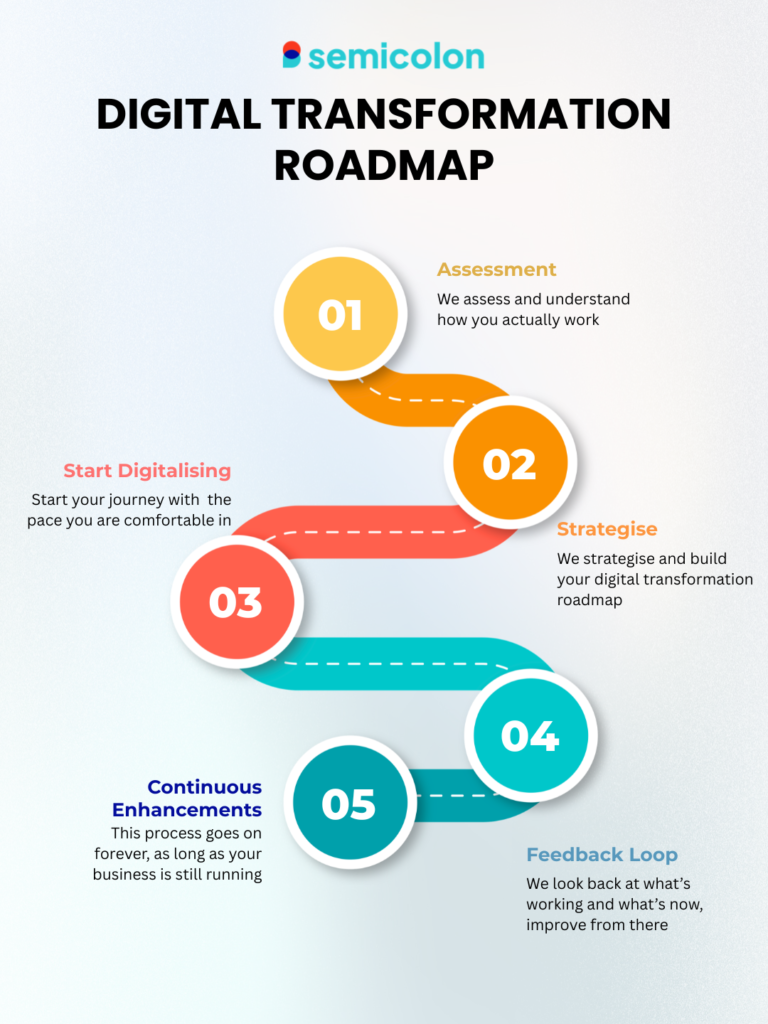
Let’s be honest, when people hear “digital transformation”, it sounds expensive, complicated, and meant for big corporations with huge IT teams. For most small businesses, the reality is: “We’re still using WhatsApp, Excel, and manual paperwork… is that bad?” Short answer – not bad, that is just your starting point. And that’s exactly where many of our clients begin. Here at Semicolon Technologies, we help local SMEs go from zero clarity to a clear, practical digital roadmap. Step by step, at a pace that makes sense for your business. We assess and understand how you actually work Before suggesting any software or systems, we sit down with you and map out: How you currently take orders How you track stock, sales, and payments Where delays, mistakes and double work happens What’s manual, messy, or eating up your time No technical jargon. Just real business flow. Think of it like drawing your business on a whiteboard, so we have a clear picture of what’s working and what can be improved with simple tech. Strategise and build your Digital Transformation Roadmap Once we understand your operations, we strategise and create a clear, realistic digital roadmap, such as: What can be digitalised first? (Quick wins) What can wait until later stages? Which tools actually fit your business size? Estimated cost and effort, no surprises Instead of jumping straight into expensive systems, we plan it in phases: Phase 1: Simple automation & organisationPhase 2: Core systems like ERP, inventory, or accountingPhase 3: Advanced reporting, integrations, and scaling You stay in control — no rushing, no overspending. Starting from zero is totally OKAY! If you don’t already know, we specialise in helping small and growing businesses. Many of our clients start with: No website, only social media accounts. No systemised workflow, everything is done differently every time. No CRM, ERP or even basic accounting platform. Just spreadsheets, notebooks and Whatsapp And that’s perfectly fine. Our job is to turn that into: Structured workflow, so people can easily learn how to complete any tasks Centralised data, so you can easily get insights to your business Less manual work Better visibility of your business performance Without overwhelming you or your team. Technology that fits your business, not the other way around We don’t believe in forcing “big company systems” onto small businesses. We recommend and implement solutions that are: Easy for your staff to learn Affordable for SMEs Scaleable as you grow Actually useful in your daily operations From ERP systems to custom process digitalisation, everything is planned based on your real needs. Your digital journey, made simple Digital transformation isn’t about becoming a tech company.It’s about making your business: FASTER MORE ORGANIZED MORE PROFITABLE EASIER TO RUN And it all starts with a clear roadmap. Ready to start, even from zero? If you’re ready for the journey, the best way to start is with a conversation. At Semicolon Technologies, we help small businesses turn confusion into clarity — and ideas into practical digital steps. Let’s map out your digital transformation together. START YOUR DIGITAL JOURNEY
Checklist: Do you need an ERP for your business?
Before we start, let’s make sure you understand what ERP actually is. ERP (Enterprise Resource Planning) is basically a system that connects all your business operations in one place — like sales, inventory, accounting, purchasing, HR, and reports. Instead of using Excel, WhatsApp, and different software separately, an ERP puts everything into one central system so your team can work faster, make fewer mistakes, and see real-time data. Think of it as the operating system that acts as the foundation for your business operations, just like you have iOS or Android that supports your favourite apps on your phone. Most Malaysian SMEs start simple. Excel sheets, WhatsApp orders, manual invoicing, maybe one accounting system here and there. That works at first. But when business starts growing, things can quickly become slow, messy, and hard to track. That’s usually when an ERP system starts to make sense. Try this quick checklist and see if it sounds like your business. You might need an ERP if: You’re using Excel to track sales, stock, and payments separately You key in the same information again and again in different systems You’re not sure of your real-time stock level or cash flow Orders get missed or delayed because everything is manual Reports take a long time to prepare (stressful end of month) Different teams use different tools that don’t connect Your business is growing but your operations still feel “kampung style” Possible ticking bombs to watch out for: Too many WhatsApp messages to manage orders Stock count always lari (never matches system) You spend more time fixing data than running the business So, is it time for an ERP? If you nodded yes to 3 or more points above, an ERP could already be helping your business run smoother from sales and inventory to accounting and reporting, all in one place. The good news? ERP today doesn’t have to be complicated or mahal. It can be customised to fit your business size and workflow. Not sure where to start? If you’re curious whether ERP makes sense for your business (or not yet, and that’s okay too), we’re happy to have a quick chat. We help local SMEs understand their processes and recommend practical systems that fit their budget and growth stage. No jargon, no hard selling. Reach out to us for a free, no-obligation consultation. I need an ERP